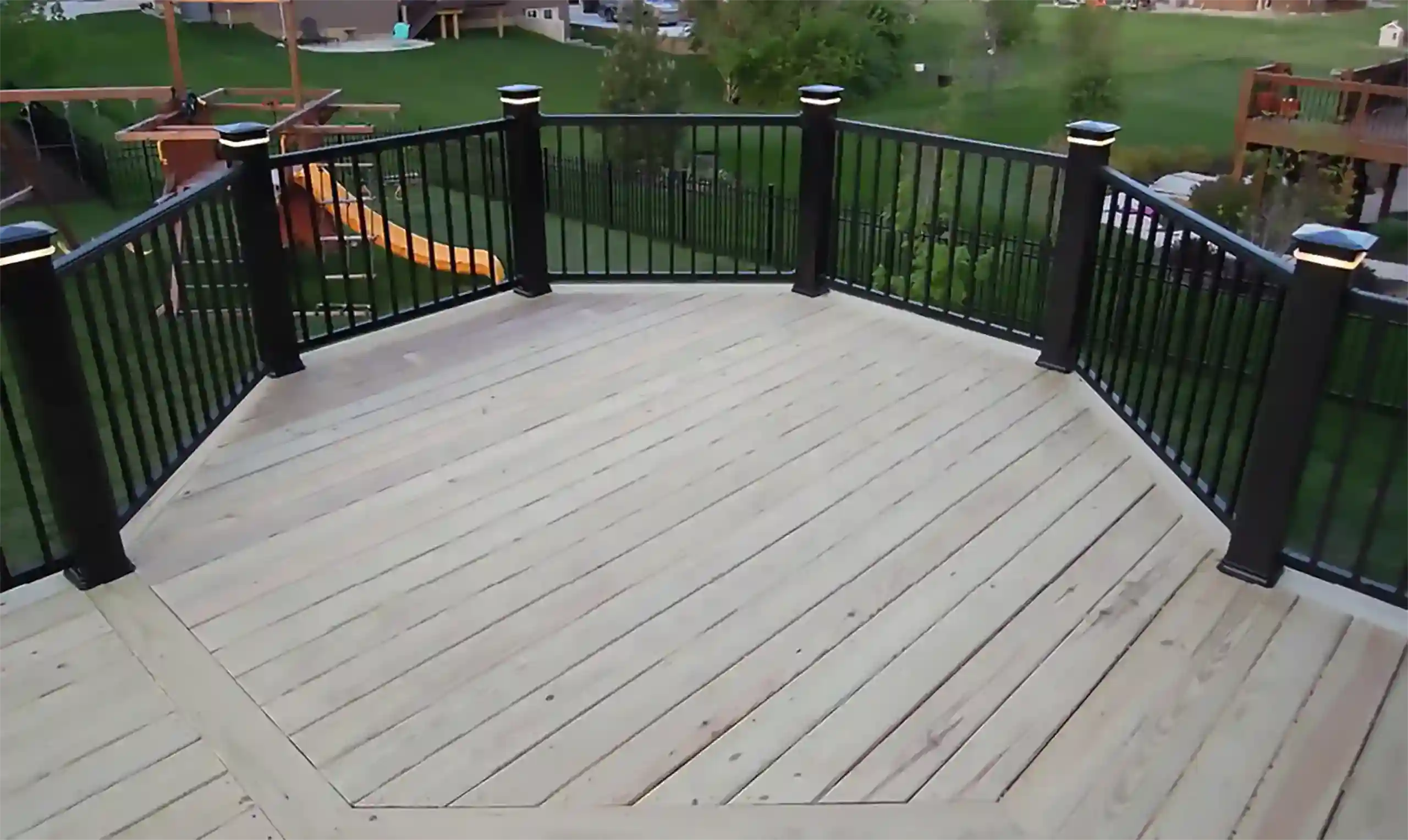
Straight lines are the default. Curved deck designs are the upgrade. A deck with smooth arcs and rounded edges changes how your yard feels, how you move through it, and how your home looks from the street. Whether you want a sweeping platform that follows your landscape, a circular conversation area, or simply a softened corner on an existing deck, curved decking opens up design possibilities that a standard rectangular build simply cannot match.
At Deck Dogs in Madison, Wisconsin, we build curved decks from the framing up, handling design, permitting, material selection, and installation for homeowners across the greater Madison area. Here is everything you need to know before you start planning yours.
What Are Curved Decks?

Quick answer: A curved deck uses smooth arcs, rounded edges, or circular shapes instead of straight lines and square corners. The result is a softer, more organic outdoor space that flows with your home’s architecture and your yard’s natural contours.
Curved decks are not a single style. They include fully circular decks, decks with one or more curved sides, rounded corners added to an otherwise standard layout, and sweeping multi-level platforms that follow a slope or treeline. Each variation delivers the same core benefit: a space that feels intentional and custom-built, not just tacked onto the back of a house.
Curved decking also solves practical problems. Irregular lots, sloped backyards, and yards with trees or garden beds often resist a clean rectangular build. A curved layout can work around obstacles, maximize usable square footage, and integrate natural features rather than fight them.
Curved Deck Designs Worth Considering

Looking at real curved deck designs before you commit to a plan is one of the best things you can do. Seeing what is possible helps you identify what fits your yard, your budget, and how you actually use outdoor space. Here are the most popular curved deck designs:
Fully Circular Decks
A circular deck, sometimes called a round deck or moon deck, creates a freestanding platform or attached extension with a complete 360-degree curve. Circular deck designs work especially well as fire pit gathering areas, hot tub surrounds, or destination platforms at the end of a garden path. Circular deck framing requires precise radial joist layout, which is more involved than standard framing but produces a result that photographs well and feels genuinely impressive in person.
Single-Curve Decks
One curved side on an otherwise rectangular deck is one of the most practical and cost-effective curved deck designs available. The curved edge faces the yard, softening the look without adding significant complexity to the entire structure. It works well for mid-size backyards where a full circular build would dominate the space.
Wraparound Curved Decks
A wraparound deck that follows the perimeter of a home, with curved corners at each turn, creates a continuous outdoor living space that flows from one side of the house to the other. Adding curved corners eliminates the sharp 90-degree angles that can feel abrupt and makes the transition between deck sections feel smooth and deliberate.
Multi-Level Curved Decks
Multi-level decks with curved edges on each tier create distinct zones for dining, lounging, and entertaining without hard visual breaks between levels. Curved deck stairs connecting the levels reinforce the flowing aesthetic and make transitions feel natural rather than architectural.
Corner Curved Decking
Rounded corners are one of the most accessible curved deck ideas for homeowners working with a standard rectangular deck. Softening one or more corners adds visual interest, creates natural gathering spots, and removes sharp edges that can be a hazard for children and pets. Corner curved decking is also a common approach when remodeling an existing deck rather than building a new one.
Curved Deck Ideas for Every Backyard

Beyond the overall shape, curved deck ideas extend into every design detail. Here are features that complement a curved build:
- Built-In Curved Benches: Bench seating that follows the arc of the deck edge creates intimate conversation areas and eliminates the need for freestanding furniture along the perimeter.
- Integrated Planters: Planter boxes built into the curved railing line or deck corners soften edges with greenery and add a finished, landscaped look.
- Curved Deck Stairs and Steps: Stairs that echo the deck’s arc rather than cutting away from it at a right angle keep the flowing aesthetic intact from ground level up. Custom curved stair treads and risers improve both safety and visual continuity.
- Curved Deck Lighting: Low-profile step lights guide movement on curved stairs, post cap lights trace the rounded perimeter, and LED strips under railings or benches add a warm ambient glow. Lighting on a curved deck does double duty, accentuating the form and improving safety after dark.
- Under-Deck Storage and Waterproofing: A curved deck over a sloped yard can create usable space below the structure. Under-deck drainage and storage systems can be integrated during the build.
- Outdoor Kitchen Integration: Curved decks can accommodate built-in grill stations, prep counters, and bar seating designed to follow the deck’s shape, turning the space into a true outdoor room.
Can You Use Composite Decking for a Curved Deck?
Yes, and it is often the best choice. Composite decking can be heat-bent into smooth curves, it holds its shape without warping or cracking over time, and it requires far less maintenance than wood. For Wisconsin winters and humid summers, that durability matters.
TimberTech and Deckorators are two of the composite lines Deck Dogs works with most often for curved builds. Both offer excellent weather resistance, color retention, and the flexibility needed for tight-radius curves when heat is applied correctly.
What is Heat-Bending?
Heat bending is the process of applying controlled, even heat to a composite board until it becomes pliable enough to conform to a curved form. Once it cools, the board holds its new shape permanently. Done correctly, heat-bending does not compromise the board’s structural integrity or warranty compliance. Done incorrectly, it causes surface bubbling, uneven curves, or material failure. This is one of several reasons why installing curved composite decking is not a DIY project.
Other Material Options for Curved Decks
- Pressure-Treated Wood: Affordable and widely available. Wood can be steam-bent or laminated to form curves, but requires regular sealing, staining, or painting to prevent warping and decay over time.
- Cedar and Redwood: Naturally rot-resistant and visually warm. Both species can be shaped through kerfing (making relief cuts on the underside) or lamination for tighter curves.
- PVC Decking: Highly durable and moisture-proof. PVC can be heat-bent similarly to composite, but typically costs more per square foot.
How Do You Frame a Curved Deck?
Curved deck framing is where the real engineering happens. Unlike a standard rectangular deck, which uses parallel joists running in a single direction, a curved deck requires radial joists, curved rim beams, and precise blocking tailored to the arc. The tighter the curve, the more involved the framing becomes.
Proper framing is what keeps a curved deck feeling solid underfoot rather than bouncy or flexy. It also determines how well the decking, railing posts, and stair stringers align with the finished design.
Curved Deck Railing Options
Curved railings complete the look and are required by code on most elevated decks. The right railing choice depends on your view, your aesthetic, and your maintenance preferences.
- Glass Panel Railings: Unobstructed sightlines and a modern, open feel. Works well on elevated decks overlooking a yard, lake, or garden.
- Cable Railings: Horizontal stainless steel cables that run between curved posts. Sleek and minimal, cables complement curved forms without adding visual weight.
- Aluminum or Steel Railings: Powder-coated for color matching, durable through Wisconsin winters, and available in a range of profile styles from traditional to contemporary.
- Curved Composite or Wood Handrails: A handrail that follows the deck’s arc creates a seamless finish. Composite handrails can be heat-formed to match the deck’s radius; wood handrails can be steam-bent or built up from laminated strips.
How Much Does a Curved Deck Cost?
Curved deck cost depends on size, materials, complexity of the curve, and the features included. Here is a general guide to help you set expectations before you start planning.
| Deck Type | Relative Cost |
| Curved corner added to existing deck | $ |
| Single-curve composite deck (mid-size) | $$ |
| Fully circular deck (composite, basic) | $$ |
| Multi-level curved deck with stairs and railings | $$$ |
Why do curved decks cost more than straight decks? The premium comes from three places: framing complexity (more cuts, more components, more time), material shaping (heat-bending requires equipment and skill), and installation labor (every board on a curved deck requires individual fitting rather than running continuous lengths). The result is a deck that is genuinely one of a kind, as reflected in both its cost and the long-term value it adds to the home.
For a precise estimate on your project, contact Deck Dogs for a free consultation.
Ready to Transform Your Outdoor Space with Curved Decking?
Deck Dogs builds custom curved decks for homeowners across the greater Madison, Wisconsin area. From the first design conversation to the final inspection, we handle every detail so you get a deck that is structurally sound, visually impressive, and built to last through Wisconsin winters.
Schedule your free estimate today and see what curved deck designs are possible for your backyard.
Curved Decking FAQs
Can you use composite decking for a curved deck?
Yes. Composite decking is one of the best materials for curved decks because it can be heat-bent into smooth arcs without cracking. TimberTech and Deckorators are two composite lines well-suited to curved deck construction. Curved composite decking also holds up well in Wisconsin’s climate, resisting moisture, fading, and temperature fluctuations better than most wood options.
What are some ideas for a curved deck?
Curved deck ideas include circular fire pit decks, sweeping wraparound platforms, multi-level decks with arced stairs, corner-curved designs that soften an existing layout, and decks with integrated curved benches, planters, lighting, and outdoor kitchens. The best starting point is to think about how you use your yard and let the design follow your habits.
Who builds curved decks near me?
If you are in the Madison, Wisconsin area, Deck Dogs builds custom curved decks throughout Dane County and surrounding communities. Not every deck contractor has experience with curved framing, heat-bending, and custom curved railing systems. Deck Dogs specializes in this type of work and can handle your project from design through final inspection.
Are curved decks more expensive than straight decks?
Yes, generally. Curved deck framing, material shaping, and individual board fitting require more labor and more complex components than a standard rectangular deck. The premium is real but so is the result: a deck that no neighbor has, that adds genuine curb appeal, and that typically increases home resale value more than a standard build.
Can TimberTech decking be curved?
Yes. TimberTech composite decking can be heat-bent to follow a curve, making it a popular choice for curved deck designs. Deckorators composite decking works similarly. Both are durable, low-maintenance options that hold their shape and color well after bending.